
In modern industries, the reliability and efficiency of piping systems depend on the quality of fittings used to connect, branch, or terminate pipelines. Stainless steel forged fittings are among the most reliable components for such sensitive applications. These fittings are made of high-strength stainless steel, ensuring durability, leak-free performance, and resistance to extreme pressure and temperature situations.
Forged fittings play an important role in industries where safety and precision are paramount. From oil refineries to power plants and pharmaceutical manufacturing, these fittings provide smooth flow and safe connections. By combining superior strength with corrosion resistance, stainless steel forged fittings have become an essential element of piping infrastructure across multiple sectors.
What Are Stainless Steel Forged Fittings?
Stainless steel forged fittings (SS forged fittings) are components created by shaping stainless steel under high pressure and heat using a process known as forging. Forged pipe fittings are manufactured by compressing solid steel billets into the correct shape compared to cast fittings which are formed by putting molten metal into molds. This results in a dense, strong and durable fitting with minimal porosity or defects.
The forging process ensures that forged fittings outperform standard fittings in terms of strength and resistance to stress. This is why sectors that require reliable, and long-lasting connections frequently prefer forged pipe fittings to welded or cast equivalents.
Types of Stainless Steel Forged Fittings
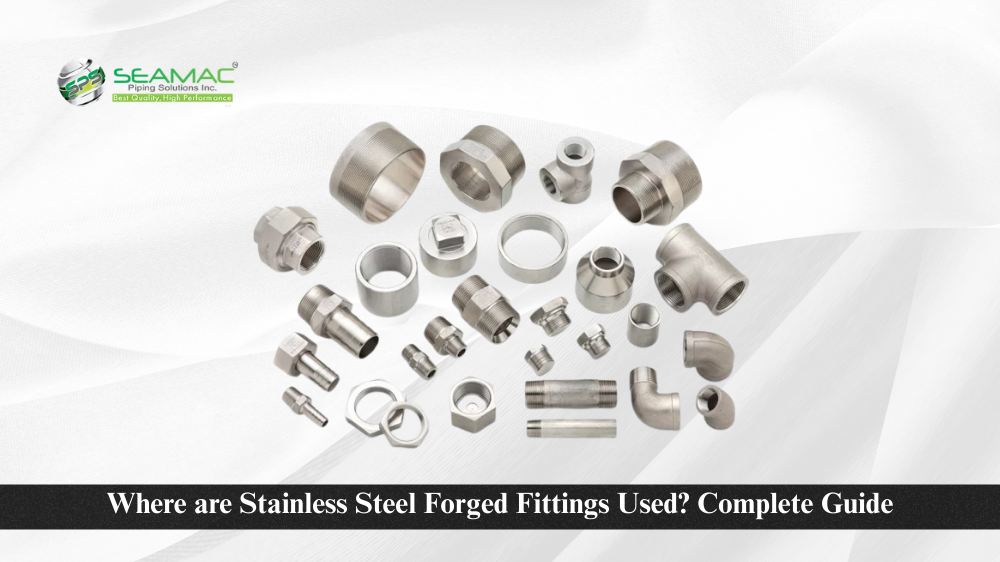
Stainless steel forged fittings are available in a variety of shapes and sizes to meet varied piping needs. The following are the most commonly used forged fittings types:
- Elbows: Used to change the direction of flow in pipelines, forged elbows are available in 45°, 90° and 180° variants. They help in reducing stress and redirecting fluid efficiently.
- Tees: Forged tees allow pipelines to branch out in two directions. They can be equal or reducing tees, depending on the size of outlets. These fittings are crucial in distribution systems.
- Couplings: These join two pipes with the same diameters. They are simple yet essential parts for repairing broken pipeline sections, or increasing pipeline lengths.
- Unions: Unions, which are more advanced than couplings make it simple to disconnect and reassemble pipelines without cutting. They are perfect
- Crosses: A forged cross has four outlets and is used where pipelines need to branch out in multiple directions. These are common in complex industrial networks.
- Caps: Caps are used to seal the ends of pipes. They provide a secure closure to prevent leakage or contamination.
- Nipples: Nipples are short lengths of pipe with threads at both ends, used for connecting fittings or extending pipe lengths.
Threaded vs Socket Weld Forged Fittings
Screw-type connections are made with threaded forging fittings, which have internal or external threads. They are ideal for small-diameter, low-pressure pipelines.
Socket weld forged fittings involve inserting the pipe into a recessed area of the fitting, followed by welding. They are more secure and widely used for stainless steel pipe fittings in high-pressure systems.
Properties & Benefits of Stainless Steel Forged Fittings
Stainless steel forged fittings offer a combination of mechanical and chemical properties that make them highly reliable in industrial applications. Key benefits include:
- Forging boosts fittings’ tensile strength, allowing them to bear high pressure and stress without deformation.
- Corrosion Resistance: Stainless steel ensures a lifespan in harsh situations by offering exceptional resistance to rust, oxidation, and chemical attack.
- Leak-Proof Connections – Their exact design and strong construction reduce leakage risks, which is critical for handling dangerous fluids and gases.
- Long Service Life in Harsh Conditions – Whether in offshore drilling or chemical processinhg, high-pressure forged fittings perform reliably for extended periods with minimal maintenance.
Where Are Stainless Steel Forged Fittings Used?
The most critical section of this guide is understanding the real-world stainless steel forged fittings applications. Their high performance makes them critical in the following industries:
Oil & Gas Industry
In oil and gas pipelines, refineries, and offshore drilling platforms, oil and gas forged fittings are essential for high-pressure and high-temperature operations. They connect pipes in crude oil processing, natural gas transportation, and refining units, ensuring secure, leak-free connections even under extreme stress.
Petrochemical Plants
Chemical processing plants and storage facilities rely on industrial forged fittings because they are resistant to corrosive chemicals and acids. They are used in reactors, storage tanks, and chemical transfer lines where durability and safety are paramount.
Power Generation
Power plants, whether thermal, nuclear, or renewable, use stainless steel pipe fittings in steam lines, cooling systems, and high-pressure boilers. Their ability to withstand high temperature and pressure makes them ideal for critical energy production environments.
Pharmaceutical Industry
In pharmaceuticals, hygienic and sterile piping systems are mandatory. Stainless steel forged fittings are used in drug manufacturing plants because they maintain cleanliness, resist chemical contamination, and comply with stringent hygiene standards.
Food & Beverage Industry
The food and beverage sector depends on fittings that prevent contamination and ensure the smooth flow of liquids. Stainless steel forged fittings applications in breweries, dairies and food-processing units include sanitary piping systems where corrosion resistance and hygiene are crucial.
Shipbuilding & Marine Applications
Ships, submarines, and marine infrastructure face constant exposure to seawater. Stainless steel forged fittings are favored for their excellent seawater resistance, making them ideal for marine piping, ballast systems, and cooling systems.
Construction & Engineering
From plumbing systems in skyscrapers to HVAC pipelines in industrial complexes, industrial forged fittings are widely used in the construction sector. Their strength, leak-proof nature, and long service life make them suitable for structural piping systems as well.
How to Select the Right Stainless Steel Forged Fittings?
Choosing the appropriate forged fittings requires careful consideration of material grade, pressure class and standards. Forged fittings in grades like as 304, 316, and 310 SS are chosen for their corrosion resistance, and temperature tolerance. Pressure ratings such as Class 2000, 3000, and 6000 assure compliance with the operational environment. Additionally, always source from reputable forged fittings manufacturers who adhere to ASTM and ASME requirements.
Maintenance & Safety of Forged Fittings
Proper forged pipe fitting maintenance is critical to ensuring safe and uninterrupted operations. Regular inspection helps detect wear, corrosion, or leakage early, preventing costly downtime. Fittings should be replaced quickly if damage is found. Preventive measures such as using protective coatings, proper welding techniques, and ensuring compatibility with operating fluids help extend their service life.
Conclusion
This stainless steel forged fittings complete guide highlights their definition, types, properties, and wide-ranging applications. From oil and gas exploration to food processing and construction, these fittings are integral to modern industries. Their high strength, corrosion resistance, and leak-proof nature make them use for safe and efficient operations. To ensure dependability, always use high-quality stainless steel forged fittings from reliable suppliers. Choosing the proper grade, according to international standards, and following maintenance requirements can ensure long-term performance in even the harsh environments.